Enter your building data and calculate
your commercial solar potential.
The Commercial Solar Advantage
Commercial buildings are uniquely suited for solar energy. With large, flat, unobstructed roofs, businesses can install massive arrays that severely cut overhead costs and improve bottom lines.
Tax Incentives & Depreciation
Capitalize on the Federal Investment Tax Credit (ITC) and MACRS (Modified Accelerated Cost-Recovery System) to write off standard depreciation in year one.
Hedge Against Rate Spikes
Lock in a predictable energy cost for the next 25+ years. Commercial solar protects your business from volatile utility rate hikes and peak demand charges.
Corporate Sustainability
Enhance your brand's reputation. Demonstrating a commitment to renewable energy satisfies ESG goals and attracts eco-conscious clients and employees.
Pros
- Excellent economies of scale lower the per-watt cost
- Flat commercial roofs hide panels from street view
- Ballasted racking means no roof penetrations
- Enormous tax benefits (ITC + MACRS depreciation)
Cons
- Requires a roof with 15-20 years of remaining life
- Complex interconnection and permitting processes
- HVAC units and skylights reduce available space
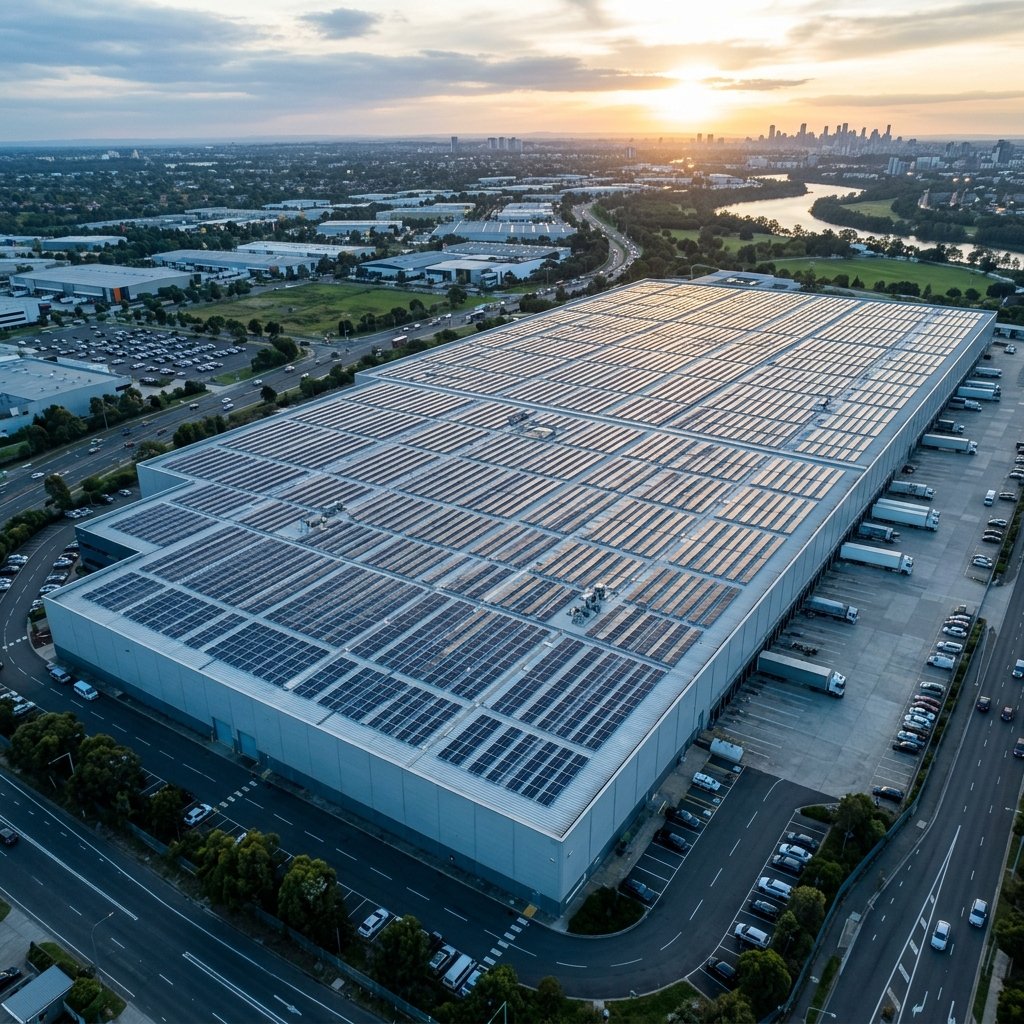
Maximizing Flat Roof Space
Commercial panels are physically larger and more powerful than residential ones, usually around 450W to 550W+, measuring roughly 6.5 x 3.5 feet. On flat roofs, panels are typically mounted at a 10-15 degree tilt using ballasted racking.
To prevent rows from casting shadows on each other, adequate row spacing must be maintained. This is why you can generally only utilize about 60% to 80% of your total open roof square footage for active panel placement.